
The fifth year of Russia’s full-scale aggression and the thirteenth year of the war overall have fundamentally changed the very way reality is perceived. What in 2022 appeared to be an acute, unprecedented, yet temporary crisis had, by the spring of 2026, finally transformed into a new normal.
A territory of total uncertainty has become the permanent living environment of an entire nation. In this context, the main existential risk is not only the physical exhaustion of resources, but also a deep internal psychological adaptation to constant tension, destruction, and darkness.
Ukraine and the free world have definitively moved beyond the period when simple scenarios or quick solutions still seemed possible. The world is becoming irreversibly more complex, old rules are changing in real time, and there are no longer any “default” answers.
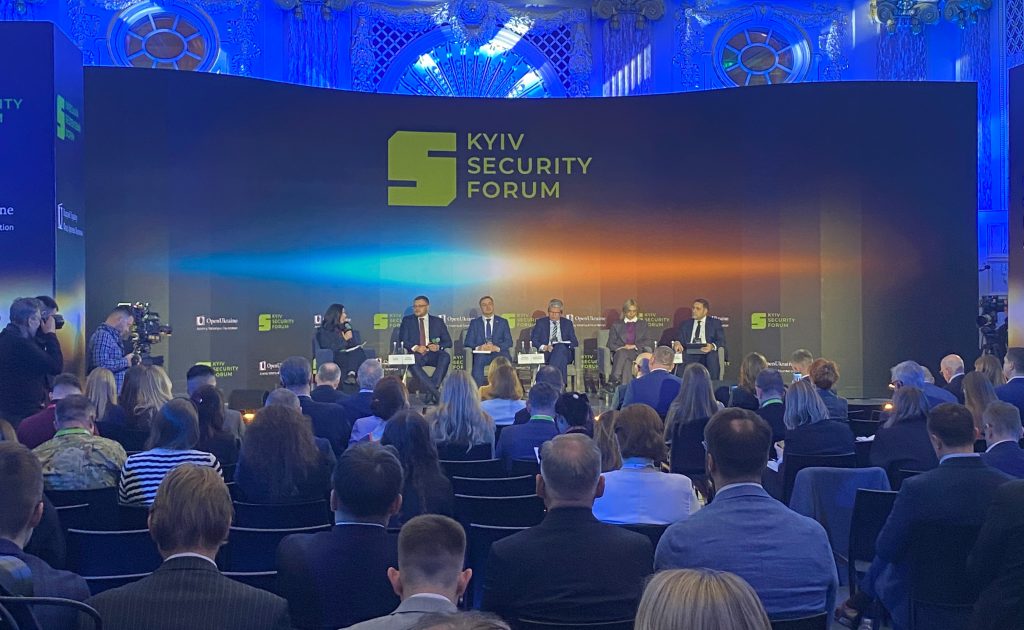
Strength as the Only Universal Currency of the Global Order
One of the central themes of discussions at the Kyiv Security Forum was the inevitability of a force-based approach in dealing with authoritarian regimes. The war in Ukraine has fully become a war of attrition, meaning the survival of the state depends entirely on its ability to endure and preserve institutional resilience. Ukrainians must not only be strong, but also feel strong and demonstrate that strength unequivocally to the outside world.
This point was particularly emphasized by former Head of Ukraine’s Main Intelligence Directorate Kyrylo Budanov, who stated: “No one in this world will deal with the weak, and international law will not help here.” Reflecting on historical mistakes — especially nuclear disarmament — Ukrainian military leadership now openly acknowledges that relying on the goodwill of the international community was a strategic mistake. Today, the only argument the enemy understands, and the only one allies truly respect, is the ability to inflict unacceptable losses and hold one’s own defensive lines.
This view was echoed by senior Western military officials. Admiral Giuseppe Cavo Dragone emphasized Ukraine’s historic achievements, noting that even after years of devastating war, Ukrainians continue to reject the idea that danger and the loss of sovereignty can be exchanged for an illusion of peace. Peace without strength is merely an illusion that encourages further aggression. Consequently, the democratic world must rethink its own doctrines: collective defense requires continuous military support today in order to build a stronger deterrence architecture tomorrow.
The disappearance of the concept of “untouchable” states has become yet another sign of this new force-driven reality. Whereas nuclear powers were once considered immune from strikes on their own territory, that psychological barrier has now been broken. Ukrainian drones regularly strike strategic targets deep inside the Russian Federation, demonstrating that the monopoly on impunity no longer exists. The old rules of nuclear deterrence no longer function as they did during the Cold War, forcing the West to reconsider the boundaries of acceptable escalation.
Global Disorder and the Middle Eastern Front: Lessons for Ukraine
Ukraine’s war is not an isolated regional conflict. It became the first and most important domino whose fall triggered a chain reaction of destabilization across the globe. Experts increasingly describe the current international situation as “World War III in parts,” where developments in Ukraine, the Middle East, and the Indo-Pacific are all elements of a single process: the collapse and reconstruction of international law.
A vivid confirmation of this came in February–April 2026 in the Middle East, where events dramatically shifted the balance of power. The military campaign launched by the United States and Israel against Iran on February 28, 2026, under the codename “Epic Fury,” demonstrated the willingness of key global actors to conduct radical preemptive operations outside the framework of a UN mandate.
Recognizing the inevitability of the nuclear threat posed by Tehran, American and Israeli forces launched a massive combined strike. During the first 12 hours of the operation, nearly 900 cruise and ballistic missiles were fired, destroying Iran’s air defense systems, missile bases, and command centers.
The strike resulted in the elimination of the country’s highest political leadership, including Supreme Leader Ali Khamenei, as well as key figures of the military establishment such as Ali Larijani and commanders of the Islamic Revolutionary Guard Corps. Iranian airspace was placed under full control by American MQ-9 Reaper drones and Israeli aviation.
However, regime change and the decapitation of command structures did not lead to immediate capitulation. Tehran’s most critical asymmetric response was the closure of the Strait of Hormuz — the main artery for global hydrocarbon transportation. This decision triggered a global energy crisis, shocks on financial markets, and forced the United States to initiate a naval blockade of Iranian ports. Ultimately, through Pakistani mediation, the parties were compelled to agree to a temporary ceasefire in early April in order to begin negotiations.
For Ukraine, this Middle Eastern crisis carries direct and extremely complex consequences. On one hand, the destruction of Iran’s military-industrial complex sharply limits Tehran’s ability to supply Russia with Shahed drones and ballistic missiles, directly affecting Russia’s capacity to continue terrorizing Ukrainian cities. On the other hand, the opening of a second global front critically diverts American political attention, financial resources, and military equipment — particularly air defense systems — away from the Ukrainian theater of war.
Moreover, the economic shock caused by the blockage of the Strait of Hormuz places a heavy burden on the European Union’s economy, potentially reducing the scale of macro-financial assistance available to Kyiv.
The Illusion of a “Machine War”
The technological dimension of modern warfare increasingly defines the nature of combat operations. Defense innovation, the development of artificial intelligence, and the expansion of cyberspace are shaping a new logic of confrontation and reflecting a deep transformation in the methods of warfare.
Unmanned systems — drones, ground robotic platforms, and naval drones — have transformed the architecture of the battlefield, making it almost completely transparent. The operational range of reconnaissance and strike systems continues to expand, while the time between target detection and destruction has been reduced to mere minutes.
However, drone warfare is not a static advantage — it is a continuous race between innovation and electronic warfare countermeasures. The effectiveness of any new technology declines rapidly unless it is constantly modernized. Without breakthroughs in artificial intelligence and signal processing, existing systems will eventually lose their effectiveness. Ukraine’s establishment of a dedicated Unmanned Systems Command is increasingly viewed as a critically necessary model for every European state.
Yet the central paradox of this technological revolution is the return to human-centric warfare. Despite constant discussions about robotics and AI creating the illusion of a “war between machines,” the human being repeatedly returns to the center of the conflict. Technology cannot fully replace the soldier; on the contrary, it requires even greater human involvement. Behind every swarm of drones stand thousands of operators, engineers, programmers, logisticians, and analysts. Moreover, no technological innovation alone can hold trenches or conduct stabilization operations in liberated territories.
The Russian Federation understands this perfectly. The aggressor is not fighting Ukrainian technology as much as it is waging a war of attrition against Ukraine’s human resources. Amid a demographic crisis caused by mass migration, declining birth rates, and combat losses, demography itself is becoming a matter of existential national survival.
The most advanced technologies and Western tanks will not save Ukraine if society becomes internally divided. Only internal solidarity, social cohesion, and a shared understanding of purpose create the “inner backbone” that allows technological power to be converted into real victory.
A Nation of Veterans: Recovery, Reintegration, and a New Pillar of Resilience
The human dimension of war is most clearly reflected in the issue of veteran reintegration. In the thirteenth year of armed conflict, Ukraine is becoming — both de facto and de jure — a nation of veterans. More than 1.2 million citizens have already obtained veteran status, and according to sociological forecasts, veterans and their families may soon account for up to 20% of the country’s population. This demographic reality requires a complete reassessment of state policy.
Veterans are not merely a vulnerable social group in need of assistance or paternalistic treatment; they are the primary pillar of national resilience and carriers of unique leadership and crisis-management experience. The state’s ability to ensure their full medical rehabilitation, psychological recovery, retraining, and integration into public administration or business will define Ukraine’s trajectory for decades to come.
One symbolic moment was the unannounced arrival at the Kyiv Security Forum of Prince Harry, founder of the Invictus Games Foundation, who spoke in support of Ukrainian veterans. Addressing participants, he described Ukraine’s resistance as “a new standard of global leadership.”
Drawing parallels with his own combat experience in Afghanistan, Prince Harry emphasized that true strength is measured not only by military power, but also by unity, trust, and the willingness of nations to endure hardship together. Ukrainian veterans are demonstrating to the world an unprecedented ability to transform traumatic experience into a driving force for social progress. Their capacity to adapt, remain resilient, and lead technological and societal transformation is what makes Ukraine a global example of strength of will.
The Sociological Dimension of 2026
The transition of the war into a prolonged and exhausting phase of confrontation is inevitably reshaping public sentiment. A detailed picture of these shifts was presented through the results of a large-scale sociological study, serving as a stark indicator of the internal state of Ukrainian society.
The most notable trend of spring 2026 has been a crisis of trust toward the United States and NATO, accompanied by a reorientation of public sympathy toward European partners. Long delays in military aid, the unpredictability of American electoral cycles, the isolationist rhetoric of the Trump administration, and Washington’s focus on Iran have led to growing disappointment among Ukrainians.
At the same time, sociology reveals an ongoing “Europeanization” of Ukrainian foreign policy consciousness. The countries viewed most favorably are those that signed bilateral security agreements, initiated defense coalitions (including drone and artillery coalitions), and demonstrated a willingness to act decisively without waiting for Washington’s approval — namely the United Kingdom, France, Germany, Denmark, Sweden, and the Baltic states.
Simultaneously, Ukrainian society is displaying extreme pragmatism regarding the prospects of ending the war. Virtually no illusions remain about the possibility of reaching a genuine agreement with Moscow. According to polling, 32.7% of Ukrainians view the government’s negotiations over a potential peace agreement as “rather unsuccessful,” while 17.4% describe them as outright “unsuccessful.”
The primary reason for this skepticism is that 61.6% of citizens believe any hypothetical peace agreement would be violated by Russia at the first opportunity. As a result, despite widespread fatigue, society categorically rejects the idea of territorial concessions in exchange for illusory peace — a position that aligns with statements from military leadership insisting that not a single millimeter of Ukrainian land can be surrendered.
However, the most acute challenge to internal resilience remains institutional corruption. Citizens rate the level of corruption at a critical 8.6 out of 10. More than half the population (56.3%) believes corruption today is worse than it was before the full-scale invasion.
This demonstrates that the internal fight for integrity is a fundamental component of national security. For years, the enemy has used corruption as a weapon to weaken state institutions, and the inability to eradicate it during an existential war threatens to undermine the very trust of society and international partners that is essential for victory.